
1
Antimatter, as the name suggests, is the opposite of matter. When matter and antimatter particles meet, they annihilate (termine tecnico? Sono ignorantello in fisica…) producing energy. But if antimatter was present in quantities equal to matter at the beginning of the universe, why do we observe only matter today?”
I found myself examining a CERN photo caption: “The experiment will be carried out for the purpose of discovering whether the mysterious Higgs boson plays any role in the disappearance of matter’s counterpart, antimatter.” The question haunted me for the rest of the day. Why is the matter crashing the antimatter?
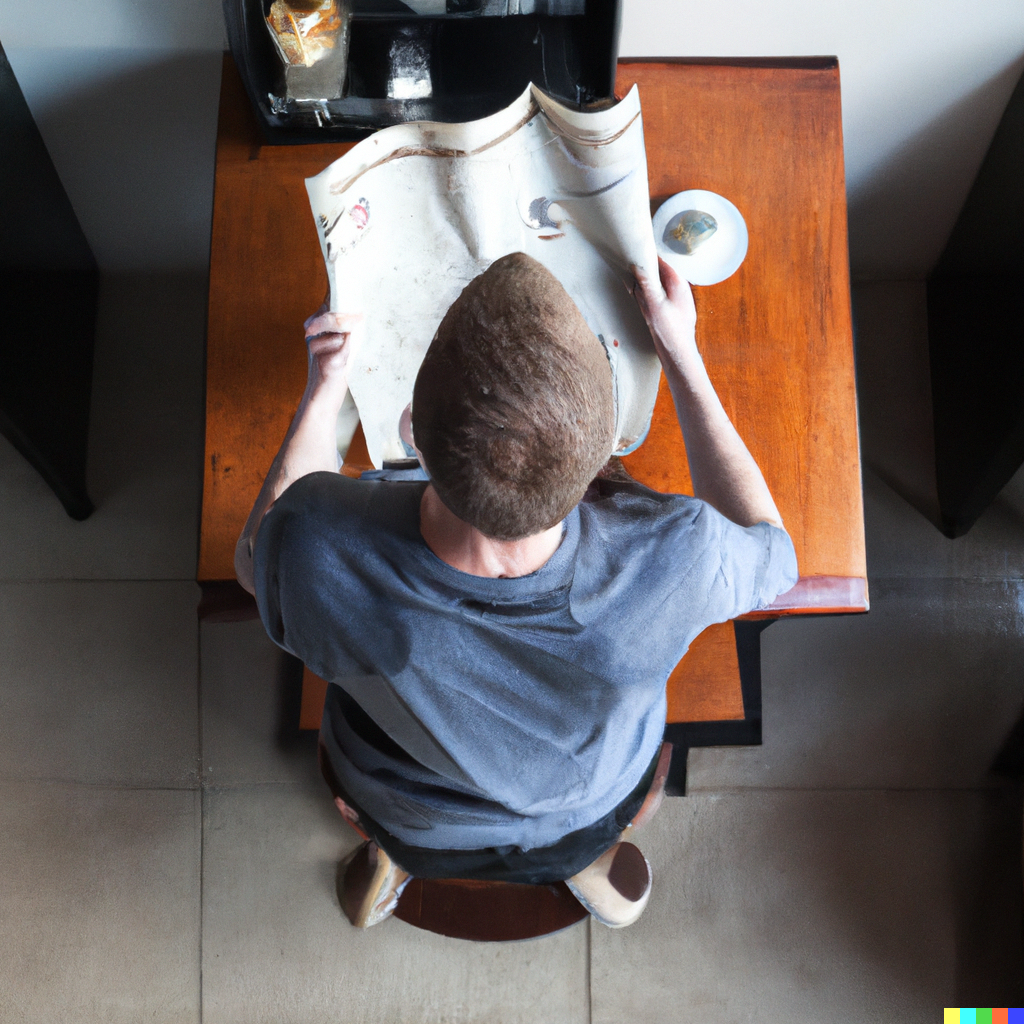
Even though I was only a science enthusiast, and not an expert, I always loved reading every piece of news related to this research while having my morning coffee. I had a basic understanding of the written words, but I never imagined the importance and sadness those words would translate for me in the future.
That, in fact, would be the last human thought I would ever read. After that morning, the world as I knew changed forever.
2
Mario faced the entrance of the bar with a smile on his lips, then he
walked toward his car that would take them both to the largest
largest do-it-yourself store south of Milan, as the advertisement signs at the entrance mentioned.
Mario, with his expert hands and eye for detail, was a true master in the DIY world. Whenever he entered the large store south of Milan where we worked together, everyone turned to look at him. Not only because he was a charismatic presence, but because he had a reputation. While I mainly did the carpentry, Mario was the wild card. With unmatched manual skills, he was often called upon to solve the most intricate problems in any department.

Stepping out to join him in the parking lot, I was hit by an unusually warm, sand-laden gust of wind. Looking into the distance, I noticed an orange sky. It was evident that an African disturbance had reached our town. I remembered a radio report I had heard that morning about the potential allergies caused by these winds for sensitive people. Concerned about Mario, whom I knew to be allergic, I ran toward him to warn him. Once I had reached him, without wasting any time, we squeezed into the car, hoping to avoid further exposure to the sand-laden wind.

As we headed toward the workplace, we found ourselves in a traffic jam, a line of cars beyond the visual horizon. Mario, with that typical critical and somewhat scheming spirit of his, shaking his head muttered, “The Chinese are behind everything.” He was convinced that they were responsible for almost all modern misfortunes. Despite our age difference, we had built a unique relationship of friendship and confidence. He often gave me advice, some bizarre, some valuable. That day, as if he had flipped a switch, he changed the subject and gave me a list of things I should do to be attractive to a woman. I sighed and said, “Come on Mario, you know I can’t. I’m disabled.” But Mario, with his inexhaustible positive spirit, did not let my words get him down and continued to encourage me, showing once again how much he cared about me.

“Don’t say these things, boy” he said. “You have a good job, you’re young, you know a lot of things, the point is that you still have Chiara in your head, it’s over. You have to turn over a new leaf.” He was right, but at that moment, I didn’t feel like dating anyone. If I did, I would have been forced to talk about my illness, and I didn’t want to feel people’s embarrassment. I preferred to stay home and study, even useless things. I was, for example, taking a course on lucid dreams. Mario asked me what they were, before I could answer, something caught our attention.

A car had jumped out of line and encroached onto the opposite roadway, ending its course against the guardrail.
Fortunately, no cars were traveling in the opposite direction. The driver had suddenly lost consciousness, was our explanation. Although the rescue people partially covered the passenger compartment, we could clearly see inside.
The passenger had also “suddenly” lost consciousness.

Then, Mario, trying to break the ice and change the subject, said, “Lucid dreams, you say?” I turned to him and nodded. “Lucky you that you have lucid dreams, I always have the … let’s say, less clean ones,” he replied with a mischievous smile.

Mario’s enthusiasm was palpable. “Can I do everything in lucid dreams? Even play soccer?”
“Sure,” I replied, “but first you have to learn how to do it. It’s not as simple as closing your eyes and starting to dream. There are rules to follow, a routine to set up during the day to condition the subconscious mind.”
Mario squinted one eye and furrowed his eyebrows. “You’re speaking to me in Arabic, I didn’t understand a single word,” he said, shrugging.
Patiently, trying to be as clear as possible, I explained, “It’s like instructing a part of you that you are not aware of. During the day, you have to ask yourself questions every two hours or so, such as ‘Am I dreaming?’ or ‘How did I get here?’ A common technique is also to look at your watch twice in a row.”

“But imagine if I remember to do these things,” Mario interrupted me, with a
sigh. “I don’t even remember what I ate yesterday. It’s not for me. For
dreaming is enough for me to drink a bottle of white wine.”
I nodded, remembering my hidden motivation behind this. Actually, the interest in lucid dreaming was not so much for the pleasure of controlling my dreams, but to find a way to escape from my condition. My illness did not allow me to take advantage of the usual escape routes such as alcohol or drugs, and at that time, I needed to find something to divert me from reality, at least for a while.
.
3
That day, covering for an absent colleague, I had earned a company van to go home. I was alone, as Mario had left at the end of his shift. I turned on the radio and listened carefully to the opening of the newspaper: a small explosion had occurred inside the newly completed particle detector inside CERN.
I was particularly struck by the news, because just that morning I had read an in-depth article about CERN’s ongoing research on the Higgs boson and antimatter. The article speculated about the boson’s potential role in the disappearance of antimatter and the revolutionary nature of this research. And now, the explosion may have compromised months or even years of research.
I immediately wondered: did the explosion have anything to do with these experiments? News of the explosion downplayed the event, but if the Higgs boson and antimatter experiments were indeed involved, the repercussions could have been immense. In an instant, simply reading about a topic in the morning and hearing it on the radio that evening made me think about the fragility and complexity of scientific research. It could not have been a mere coincidence.

I parked the van under the house, meeting Mrs. Dagmar from the third
floor, an infirm and nearly deaf old German woman, intent on throwing out the
garbage. I greeted her politely, but received no response.

I retreated into the house, before getting into the shower, I lowered the blinds.
I unrolled the cord and noticed a faint light in the distant darkness, a wall
of rain approaching ominously. The shower door, as always,
remained in my hand and reminded me that I would have to fix it the following weekend, but I knew I would not. Thus, to get in and out of the
shower, I had to lean the Plexiglas panel in the corner.

 yet another human apocalipse